Keeping your guests safe is the most critical part of managing a holiday let. However, whether you run a cosy countryside cottage, a remote lodge, or a glamping site, navigating fire safety legislation can feel overwhelming.
In November 2024, the Home Office published updated guidance specifically for small paying-guest accommodation, titled “Making your small paying guest accommodation safe from fire“. This blog breaks down what you need to know to ensure guest safety and remain compliant with the law; however, we strongly recommend you read the office guidance in full.
Who does this guidance apply to? This update focuses on premises with simple layouts and limited fire risks, such as self-catering properties. Specifically, it applies to:
- Single premises consisting of a ground floor only, or a ground and first floor.
- Properties sleeping a maximum of 10 people, with no more than four bedrooms on the first floor (e.g., houses, cottages, and chalets).
- Individual flats, whether in a purpose-built block or a converted house (excluding unusually large flats).
The Legal Position: You Are the “Responsible Person” 
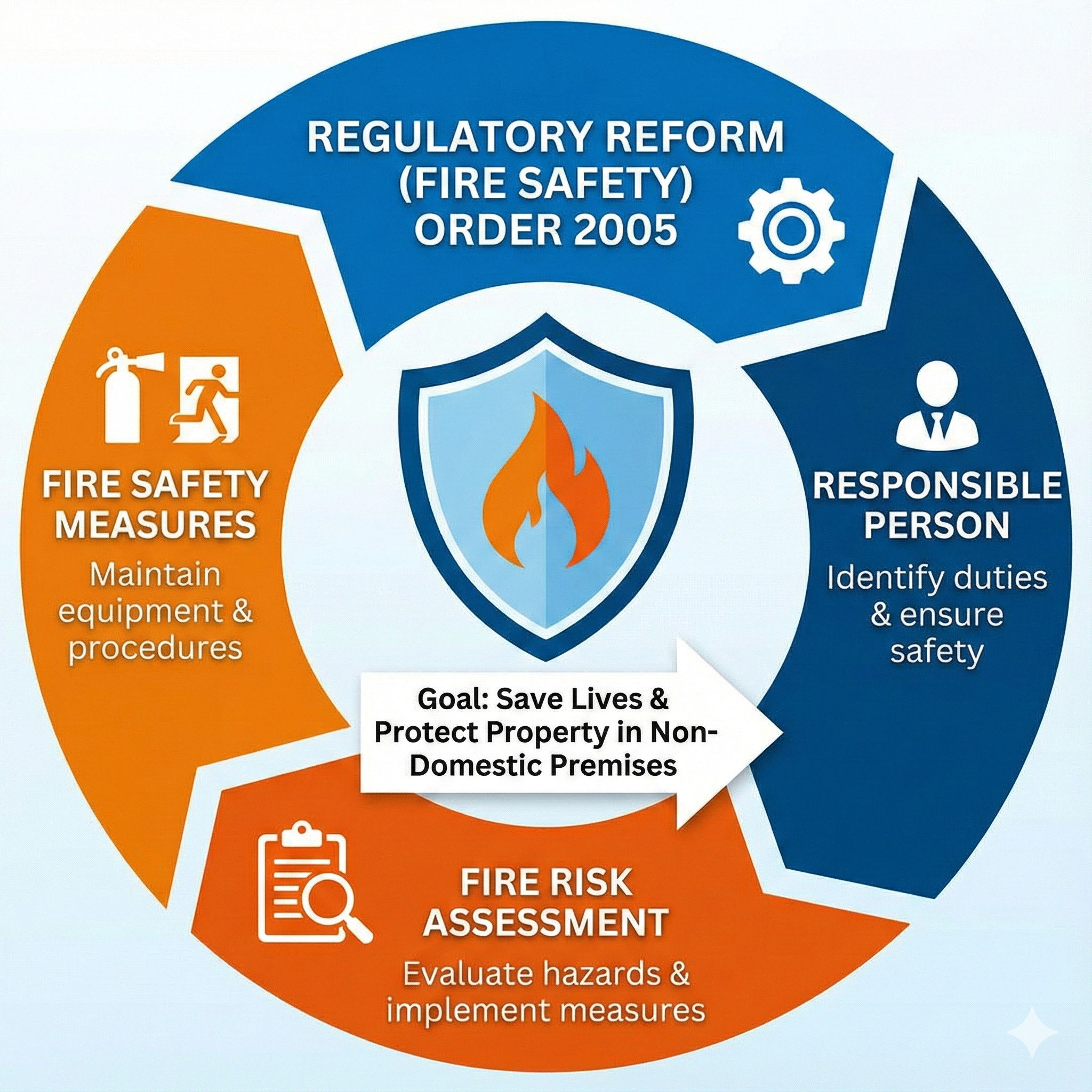
Under the Regulatory Reform (Fire Safety) Order 2005, the person responsible for the premises—usually the owner—is legally defined as the “Responsible Person”. It is your absolute duty to take reasonable steps to reduce the likelihood of a fire starting and to ensure that, should a fire occur, everyone can evacuate to a safe location.
Does the guidance matter in court?
Yes! The recent guidance was issued under Article 50 of the Fire Safety Order. While you don’t have to follow the technical advice to the letter if you have a better solution, proof that you complied with this guidance can be relied upon in court to establish that you have met your legal obligations. Conversely, proof that you deviated from it can be used to establish a breach of the law.
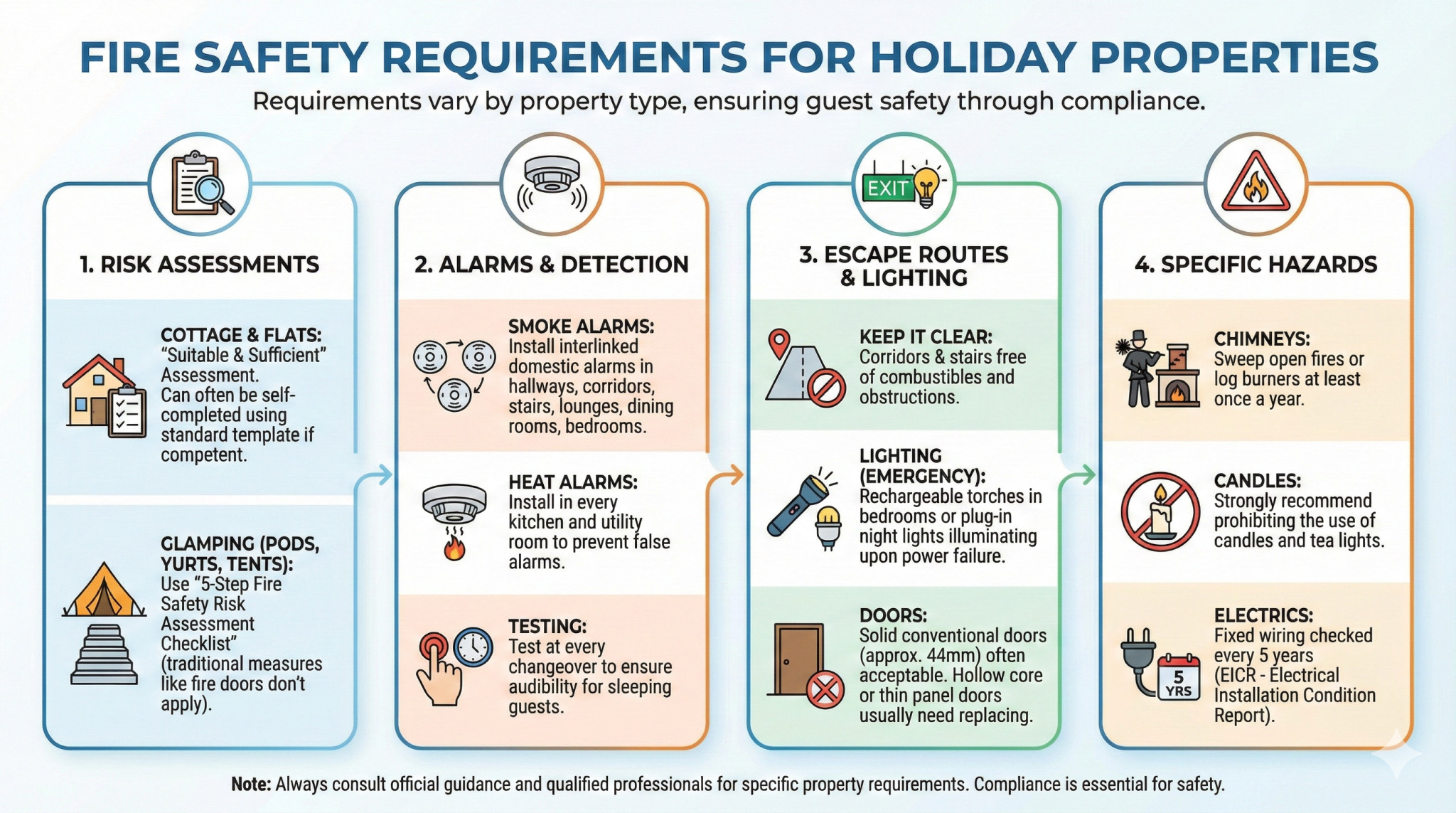
Fire Safety Requirements for Holiday Properties
The requirements vary depending on the type of property you operate.
1. Risk Assessments
You must carry out a “suitable and sufficient” fire risk assessment to identify the risks specific to your property and what mitigation is required.
- For Homes, Cottages and Flats: You can often complete this task yourself using the standard template provided in the guidance, provided you feel competent to do so. However, if you are in any doubt whatsoever, we strongly suggest engaging a suitably qualified Fire Risk Assessor to assist you. Fire Safety is not something you should chance.
- For Glamping (Pods, Yurts, Tents): The main guide recommends using the “5-step fire safety risk assessment checklist” rather than the standard template, as traditional measures like fire doors don’t apply to tents or caravans.
- Regular Review: Your risk assessment must be reviewed regularly, at least annually, or whenever there is a significant change to the property’s structure or layout.
2. Alarms and Detection
- Smoke Detection Alarms: In a typical small property, you should install interlinked domestic smoke alarms in hallways, corridors, staircases, lounges, dining rooms, bedrooms and any room where a fire might start.
- Heat Detection Alarms: These should be installed in kitchens, utility rooms, and any room where smoke detection might be susceptible to false alarms, such as those caused by cooking fumes or burnt toast.
- Testing: You should test the detection at every changeover to ensure all are working correctly. Testing one detector must set off all the other detectors (interlinked). Choose a different detector to test at each changeover. Ensure that you log the date and time of the tests, along with any actions taken if an issue is identified, in either a fire test logbook or digitally. Remember, if the Fire Authority inspect your property, they will very likely ask to see your records of testing.
3. Escape Routes and Lighting
- Signage: Someone staying in your accommodation is unlikely to be familiar with the premises. If an alarm goes off during the night when people are asleep, they will be able to evacuate more quickly if you have informed them of the necessary actions at the beginning of their stay. A Fire Action Notice must be provided in the property, and a simple floor plan drawing highlighting evacuation routes may be helpful for guests.
- Keep it Clear: Corridors and stairs must be kept clear of combustible materials and obstructions.
- Doors Along Escape Routes: Doors leading onto your escape routes should be constructed of materials that can withstand smoke and fire for an extended period, allowing guests sufficient time to escape. While fire doors with a minimum 30-minute fire resistance are the gold standard, in many low-risk properties, solid conventional doors (typically 44mm thick made of solid timber) with a good fit in their frames are acceptable. Hollow core “egg-box” doors or thin panel doors typically offer little resistance and usually require replacement with a door that provides suitable protection.
- Thumb-turn Locks: The final exit doors (usually the front or back door) should be fitted with a thumb-turn lock or similar device that does not require a key to open from the inside. Guests should never have to search for a key in a panic.
- Emergency Lighting: If the power fails at night or an electrical fire trips the fuse board, can guests see their way out in the dark? For small premises, simpler solutions, such as battery-powered, rechargeable, plug-in torches in bedrooms and hallways, are often acceptable, provided they light up automatically when the power is cut.
4. Fire Fighting Equipment
For unstaffed self-catering accommodation, the priority is evacuation, not fighting fires. However, you should provide:
- A Fire Blanket: Mounted on the wall in the kitchen.
- Extinguishers: Consider providing a suitable fire extinguisher in the kitchen. Low-maintenance “P50” Watermist extinguishers with a 10-year lifespan are now available, eliminating the need for an annual servicing contract. Powder extinguishers are generally not recommended for indoor use due to the reduction in visibility when discharged, and should be replaced.
5. Specific Hazards
- Chimneys: If you have an open fire or a log burner, your chimney must be swept at least once a year.
- Candles: It is strongly recommended to prohibit the use of candles and tea lights entirely.
- Kitchen Hobs: Consider replacing gas or traditional electric hobs with induction hobs.
- Electrics: Fixed wiring should be checked every five years. This is known as an “Electrical Installation Condition Report”, or “EICR” for short.
The Challenge of Open Plan Layouts
One of the most complex areas for holiday let owners is the “open plan” ground floor, where the staircase descends directly into a lounge or kitchen/diner.
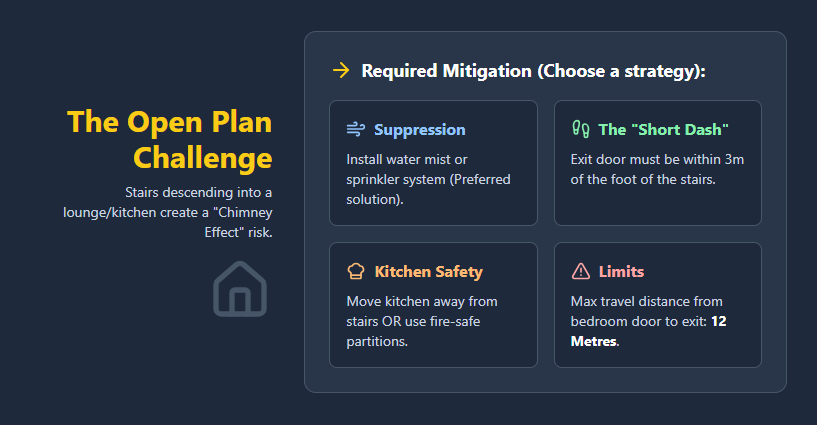
The issue is the “chimney effect”. If a fire starts in the kitchen or lounge, smoke can rise up the open staircase, trapping guests in the upstairs bedrooms.
Can I have an open-plan ground floor?
The general rule is that single staircases leading to an open-plan ground floor are not acceptable for sleeping accommodation unless specific mitigation measures are in place.
Mitigation Measures
If you cannot enclose the staircase, you may need to implement a “package” of measures to make the property safe. According to the PASC UK Advice Note and Annexe A of the guidance, these may include:
- Suppression Systems: Installing a water mist or sprinkler system is a highly effective way to suppress a fire and is often the preferred solution for open plan layouts.
- Distance Limits:
- The travel distance from the furthest bedroom door to the exit should generally not exceed 12 metres.
- The distance from the foot of the stairs to the final exit (the “short dash”) should ideally be no more than 3 metres.
- Kitchen Safety: Locate the kitchen away from the stairs or separate it with a fire-resistant partition.
- Cooking Safety: Consider induction hobs or cooker safety cut-off switches (e.g., Airis or similar) that turn off the heat if a fire risk is detected.
- Escape Windows: Crucially, escape windows on the first floor are not considered a suitable means of evacuation for paying guests, as they may be elderly, less mobile, or unfamiliar with the window mechanisms.
Conclusion
Fire safety is about more than just ticking boxes; it is about ensuring that the families and friends who stay in your property can sleep soundly.
As the Responsible Person, you are responsible for identifying and managing risks. While you, as the Owner, might be able to assess your small property, if your property has an open-plan layout, a complex layout, or unique features, it is highly advisable to engage a competent fire risk assessor to help you design a safe solution.
By following correct guidance as issued by The Home Office, you protect your guests, your business, and yourself.